
Back to: From idea to business concept – Journal Course
After this lesson you will have defined your idea and checked the potential of your idea as a way to earn money.

You have an idea that you would like to earn money with. In this lesson you will look at framing your idea. This means that you write your idea down as clear as possible at this stage. And in such a way that it is ‘a big and bold idea that makes you feel excited’.
Get some A4 size paper and a pen and let’s get started.
Writing down your idea
1. What is your idea?
Write your idea in one clear sentence.
2. Who is it for?
Try to be specific. Your idea is not for everyone so try to discribe the type of person you have in mind.
3. What problem does it solve?
What is frustrating, inefficient, or missing that your idea is the solution for?
4. Why this idea?
Why does your idea matter now? And why are you the person to offer it?
5. What is this NOT?
Also define the boundaries of your idea. What are you leaving out?
6. Summarize your idea
Combine what you have written down in step 1-5 to a more clarified idea.
7. Make a poster of your idea
Write your idea, as big as possible, on a separate A4 size paper (or 2 A4 pieced together for more space) and hang it on the wall.
Take a step back and take a look. What happens, does this give a feeling of excitement? Maybe even scare you a little? Great! Because really if it is not something that get’s you excited, there is no need to invest time and money in it.
TIP: Talking your idea through with someone who know’s you well but is also happy to be critical if this helps you forward, can be very helpful.
This episode of the tv-series ‘the Big Bang Theory’, where Penny decides to sell handmade Penny blossoms (hair accessory), shows you that sometimes an idea is just not going to be a way to earn money. And, in the last seconds, it also shows how important your process and promotion are…
Checking the potential of your idea
With the potential check in the graphic below, you can find out if your idea has potential as a way to earn money. In the best case you discover this is possible. In the worst case you discover you need to adapt your idea before you continue to the next lesson.
First look at the potential check of starting a coffee bar. This gives you an idea of what you need to figure our for your idea.
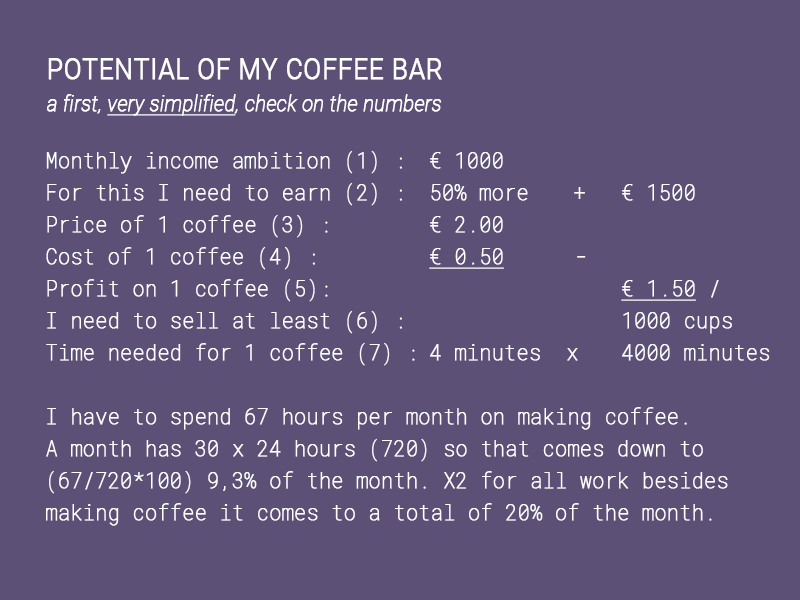
Let’s start gathering some numbers. Take a sheet of paper and list for steps 1 to 7 what your numbers are. With these numbers, you will make your first check. Very simplified, but very important as a starting point.
1. Income ambition on a monthly basis
…………. a month makes that I can provide / or contribute to a good living for me and my family.
2. Amount I need to sell for to generate this income
Your monthly income is the amount after paying taxes so add 50% to get a rough idea of what you need to generate by selling your service or product. I need to sell for an amount of at least ………… each month.
3. A reasonable price I can ask for my service or product
…….. for each item is a price people will likely pay. Look at what others ask for a similar kind of service of product. Don’t worry if you think you make something totally new, there is always someone, somewhere in the world, delivering the same type of service or product if not the exact same service or product. If this in another part of the world where prices are much higher of lower you can check with some friends “would you pay this and if not what would you pay for this here?”.
4. Costs to make my service or product
There are two sorts of costs. The ones that you have to make for each item and your general costs such as renting space, electricity and water bills, computer(s) and other machinery, personel etc. For this initial check we will not include the main costs because they need to be divided by the number of products / services and you do not know yet how much at least you need to sell. I need to spend ……………….. for each service or product (costs for buying materials needed for the production, this may also include transportation costs and import tax for a product that you buy outside of your country).
TIP: Import tax rates can be found on your countries Customs website. What you will discover if you look into them, is that a finished product is way more expensive to import than an ingredient.
5. Profit for each item (product or service)
The difference between the price per item and the costs per item is the profit you can make with your idea. The check in this lesson is an initial and rough calculation. You will need to look more closely at this later in the course. For now it will show you if it is in potential possible to make an income with your idea. …… sales price (3) for each item minus …… costs (4) for each item gives a profit of …. for each item (5).
General rule is that the selling price should be preferably 8 times more than the costs. But certainly not less than 4 times more. In this first potential check we have left the general cost out. So if your selling price is only 4 times more than the costs it will be very difficult to earn an income. In our coffee bar example this is the case, so we have to look into making more profit.
6. Amount that I need to sell
To generate the amount that I need to earn each month ………………. (2) / profit per item ………………. (5) = ……… items per month.
7. Time needed to create my service or product
……… minutes are needed to make 1 item.
Potential of my idea
With all numbers you gathered, you can now check if you can earn a living with your idea:
I need to sell ……… items per month (6) to get to my income ambition and this will take me at least …… minutes a month (6*7). This comes down to ………… hours (8/60) a month. An average month has 720 (30*24) hours so this is … % (number of hours / 720 * 100). Double this percentage and you will see how much of all hours there are you will be spending on your idea. Doubling the percentage is for two reasons. If you want something you are most likely too optimistic and you will spend time on administration, shopping for your business, finding customers etc. etc. If the final % comes around 60% you can at least sleep 8 hours a night and have time for a social private life.
To write down in your notebook (pages 7+10-13)
- Write your, now more defined, idea as “INITIAL IDEA” on page 7 of your notebook. Use a pencil because your idea will change later on during this course.
- Write your potentail check on page 10 and 11 of your notebook. If the outcome is not positive enough it will still give you an idea of how you could change your idea so that it does have the potential to provide an income. Make notes about this on page 11.
TIP: If the likely selling price of your idea is only 4 times more than the costs you will be able to find solutions for this during this course. Like I said in the first lesson: your idea will surely change!
- Make a first Marketing Mix in pencil on pages 12 + 13 . This will help you when you start analysing the world around you and your idea in the next lessons. Go back to lesson 3 and copy the C’s on page 12 and the P’s on page 13. At this stage you only have to write your P’s on page 13.
Further reading / watching

When you will be spending so much time on a business, you want it to be something you love doing. In Japan they call this Ikigai – finding purpose. There are many books, video’s and blogs to be found, when you search online for Ikigai. This article gives a nice explanation (long read). I have made a template with instructions for you. Use this Ikigai worksheet and create your own Ikigai picture in the Random Notes section of your notebook so you often see it when you write down new ideas. Does your purpose match with your idea? Great if this is the case and if it’s not maybe you want to adjust your idea.
After you hit the ‘Mark Complete’ button you will receive tips and inspirations by email.